How SEO Should Actually Fit Into Your Marketing Plan
I see this pattern all the time.
A business has a marketing team. There’s someone managing content, someone handling email, someone working on social or paid ads. Maybe there’s a web developer involved, maybe not. There are campaigns, launches, quarterly goals, and a lot of moving pieces.
And then there’s SEO.
SEO usually sits off to the side. Sometimes it’s outsourced to an agency. Sometimes it’s “kind of handled” by whoever touches the blog. Sometimes it’s just assumed to be happening in the background. Reports show up once a month. Rankings are mentioned. Traffic numbers go up or down. And then everyone moves on.
What’s missing most of the time isn’t effort or intent. It’s integration.
SEO isn’t failing because people don’t care about it. It fails because it’s treated like a separate project instead of part of the marketing system.
Why SEO doesn’t work well in isolation
SEO is often described as a channel, but that framing is part of the problem. In practice, SEO is less about execution and more about prioritization. It’s about deciding what to focus on, when to focus on it, and how that work supports the bigger business goals.
Those decisions can’t be made in a vacuum.
If the person responsible for SEO doesn’t know what’s launching next quarter, what offers matter most right now, or how success is being measured across the rest of the marketing team, the work will always be slightly misaligned. Even if it’s technically “good” SEO.
This is why you see situations where traffic is growing, rankings look fine, and yet no one feels confident saying SEO is actually working. The numbers don’t connect cleanly to revenue, pipeline, or growth priorities. So SEO ends up feeling vague and hard to defend.
The problem is the system.
I’ll give you a real example of how this shows up.
A landscaping company owner reached out because he wasn’t getting qualified leads from his SEO agency and was considering switching providers.
What he actually wanted was very specific. He wanted full landscape design projects, not monthly yard maintenance. And he wanted customers from surrounding areas, not just Seattle.
When I reviewed what was happening, the SEO work itself wasn’t bad. In fact, from a technical standpoint, it looked solid.
The website and Google Business Profile were optimized for “landscaping services,” not design. The contact form didn’t filter out people looking for ongoing maintenance. Service locations existed, even with location landing pages, but they weren’t prioritized. Blog content and portfolio work focused almost entirely on Seattle, despite the business wanting to serve a wider area. Even reviews and review replies never reinforced location.
Traffic was coming in. Leads were coming in.
They just weren’t the right leads.
That wasn’t a failure of SEO execution. It was a failure of communication and alignment.
The business owner didn’t do anything wrong. He’s not a marketer, and he didn’t know what questions to ask. The real issue was that the agency never pushed to fully understand the business goals or keep them front and center as the strategy evolved.
This is what happens when SEO operates in isolation. Even good work can quietly miss the mark.
SEO’s real role inside a marketing plan
When SEO is integrated properly, it acts more like connective tissue than a standalone function. It helps tie together content, paid media, distribution, and site experience around shared goals.
That starts with content.
SEO should be influencing what content gets created in the first place, not just optimizing it after the fact. If your business is pushing a specific service, product, or offer this quarter, SEO should help shape the topics, structure, and internal pathways that support that push. That’s how content clusters form naturally, instead of becoming a collection of disconnected blog posts.
Internal linking plays a big role here as well. It’s one of the most overlooked parts of SEO, but it’s also one of the clearest ways to reinforce priorities across your site. Internal links are signals. They tell both search engines and users what matters most right now. When SEO is disconnected from content planning, this layer is usually missing or inconsistent.
SEO also needs to be in conversation with whoever touches the website itself. Technical SEO doesn’t require constant deep development work, but it does require access. Things like page templates, schema, navigation structure, and site performance all influence how well content can perform. When SEO requests are filtered through multiple layers or handled asynchronously through tickets, momentum slows and nuance gets lost. So web developers and CRO teams should be in communication with SEO.
Paid media is another area where integration matters more than most teams realize. SEO and PPC are both keyword-driven, but they serve different purposes depending on competition, timelines, and budget. Without coordination, it’s easy to waste money bidding on terms you already rank well for, or to ignore high-intent keywords that would be unrealistic to win organically in the short term. When SEO and paid teams share insights, both sides tend to perform better.
And then there’s distribution.
SEO content shouldn’t live quietly on the blog and wait to be discovered. If you’re investing in content creation, it should be supported by email, social, partnerships, or other distribution channels you already have in place. SEO creates entry points, but distribution creates momentum. When those efforts aren’t connected, you end up underutilizing the work you’ve already paid for.
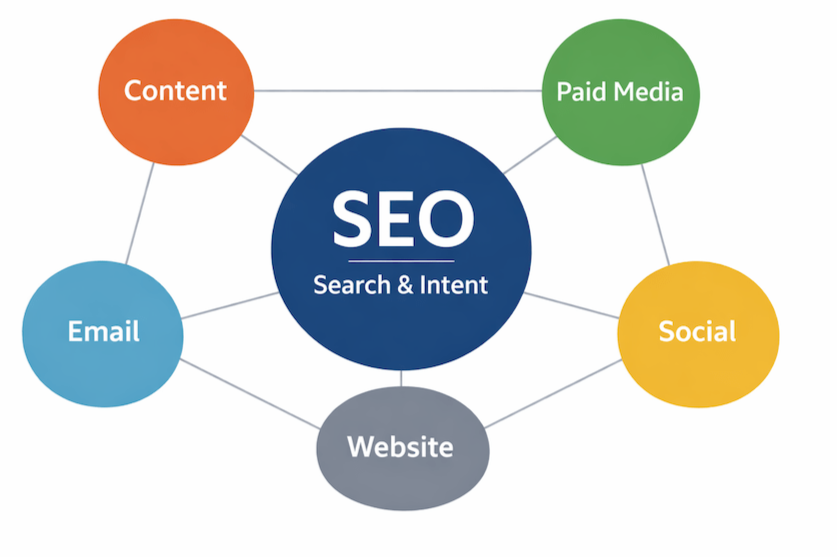
SEO works best when it’s connected with the rest of your marketing channels.
What “embedded” SEO actually looks like
When I talk about embedding SEO into a marketing team, I’m not talking about org charts or job titles.
I’m talking about proximity.
SEO works best when the person responsible for it understands the business well enough to make tradeoffs. That means being aware of upcoming launches, sitting in on planning conversations, and having clarity on what success actually looks like for the business right now.
It also means shared language around metrics. Instead of vague reports about rankings or impressions, SEO performance should be discussed in the same context as other marketing efforts. How is this supporting pipeline? How is it influencing conversions? Where is it contributing, and where is it not?
That level of alignment doesn’t require a full-time hire in every case. It does require ownership.
Sometimes that ownership lives with an in-house SEO lead. Sometimes it’s a fractional role. Sometimes it’s a consultant who’s deeply embedded in planning and communication. The structure matters less than the integration.
What doesn’t work well is treating SEO as something you hand off and hope for the best.
If you’re working with an SEO agency
Many teams do work with agencies, and that can absolutely work. But agencies need context to be effective.
If SEO is outsourced, it’s especially important to communicate clearly about priorities. Agencies should know what’s launching, what matters this quarter, and how success will be evaluated internally. Reporting should reflect those goals, not just generic SEO metrics.
The more an agency understands how the rest of your marketing functions operate, the more useful their work becomes. Without that connection, even well-executed SEO can feel disconnected and hard to justify.
Bringing it all together
The marketing teams that see the strongest results from SEO don’t treat it as a box to check. They treat it as part of how decisions get made.
SEO isn’t just about keywords or technical fixes. It’s about understanding demand, aligning content with intent, and making sure your website supports the goals your business is actually working toward.
When SEO is embedded into the marketing plan instead of operating on the sidelines, it stops feeling mysterious. It becomes easier to prioritize, easier to report on, and easier to tie back to real outcomes.
If you’re responsible for marketing results and SEO currently feels disconnected from the rest of your strategy, that’s usually not a performance issue. It’s an integration issue.
If you want help embedding SEO into your marketing team in a way that aligns with your goals, planning cycles, and existing channels, you can learn more about how I work as a fractional SEO lead here:
👉 Fractional SEO Lead





SEO and ads work best when in collaboration. PPC gives immediate results, but SEO gives sustainable results with better ROI. So how do you balance the two?