How We Tripled Sales by Treating a Blog Like a Business Asset
Sales from organic search have tripled.
In two months.
And when I look at what’s actually driving that growth for this product-based business right now, it’s not ads, and it’s not new product launches.
It’s the blog.
It’s the content.
More specifically, it’s what happens after the foundations are in place and you finally give your website something to work with beyond product and collection pages.
This is a current client. This is current data. And this is the exact phase a lot of businesses find themselves standing on the edge of without realizing it.
They’ve done the hard part.
Now they’re wondering how to level up.
This is it.
Product/Service Pages Come First. They’re Just Not Enough.
For ecommerce businesses, my roadmap always starts in the same place.
We fix the foundations first:
Site structure and architecture
User experience
Technical issues that block growth
On-page SEO for the most important pages
Product and collection pages that actually convert
Off-page business profiles and directories
Those pages matter because they capture existing demand. When someone already knows what they want, that’s where sales happen.
And once those pages are solid, they usually perform well. You see steady growth. Conversions improve. Revenue moves in the right direction.
But product pages can only take you so far.
They don’t cover all the ways people search. They don’t meet someone early in the decision-making process. They don’t answer questions, show use cases, or build confidence before someone is ready to buy.
So once the foundations are strong, growth naturally slows unless something else steps in to support it.
That “something else” is content.
Let’s take a look at the metrics.
Here’s how the overall site has grown. Slow at first, and then huge gains.
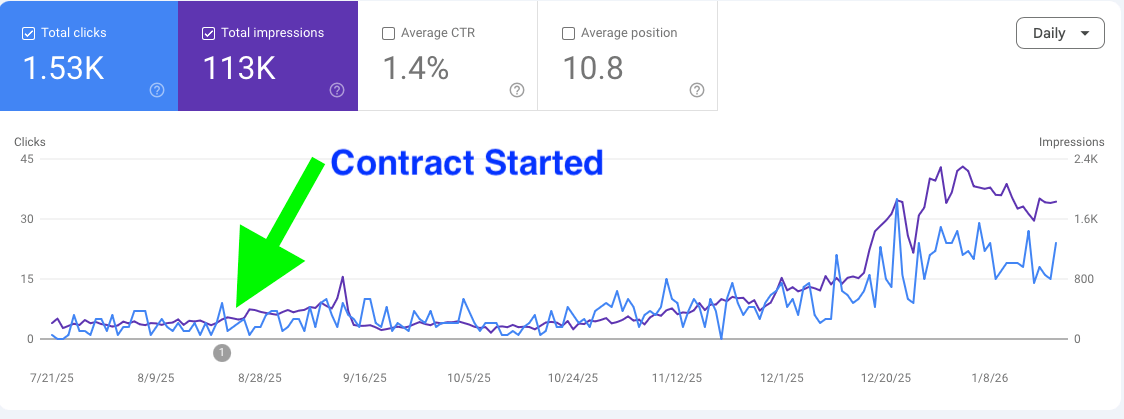
All pages included, the site made some major growth the last few months.
Here’s how product pages have grown in impressions and clicks. Slower, steady growth. Not the big jump you see I the first graph. So where are those clicks coming from? (hint… answer comes next)
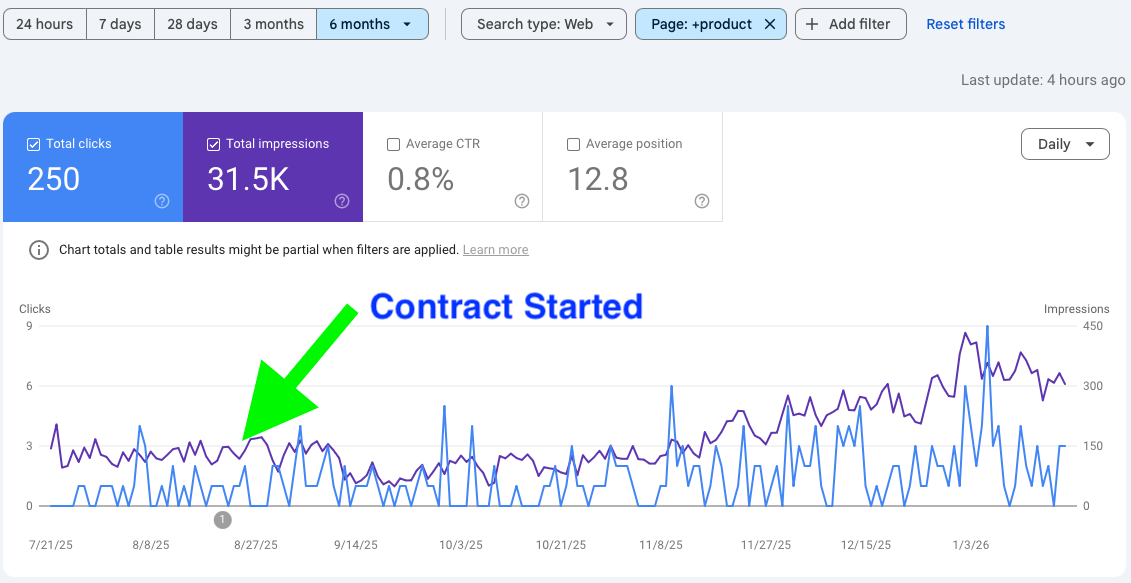
Slow steady growth to product pages with SEO over time.
Blogging is the Next Phase.
This was always part of the plan.
Once the foundational work is done and the site is technically sound, the next phase of growth is about expansion. About widening the net of how people can find you and why they trust you. So after the foundations are in place, we move to blogging and building backlinks (which at this point we haven’t even really started yet).
Typically once the foundations are set, growth is made, but at some point it starts to stall. But we didn’t wait for it to stall.
Even though sales from organic search had doubled just from the foundational work, we jumped right into the next step. The blog.
So that’s when I run a content audit and start asking bigger questions:
What content already exists that could work harder?
What content is dead weight and can be removed?
Where are the gaps, especially closer to the bottom of the funnel?
How are people supposed to move from content to products right now?
In this case, that audit revealed two big opportunities.
Putting Content Into the Right Structure So It Can Perform
This business already had recipes. Short, simple, useful recipes that people actively search for. The issue wasn’t the content itself, but was how it was stored.
Those recipes were living as blog posts, which limited how they could appear in search. So we moved that same content into a different type of page in the CMS, one that follows a consistent format and allows for recipe schema.
That change matters more than most people realize.
Recipe schema is what allows content to show up in recipe-specific search results, with images and rich features that actually earn clicks instead of getting buried in standard blue links.
We didn’t fluff the content. We didn’t add unnecessary length. We simply put it into the format it needed to be in to compete.
Once that happened, traffic didn’t inch up slowly.
It jumped.
You can see the exact moment it happens in the data.
That’s the power of treating content like an asset instead of just “something you wrote.”
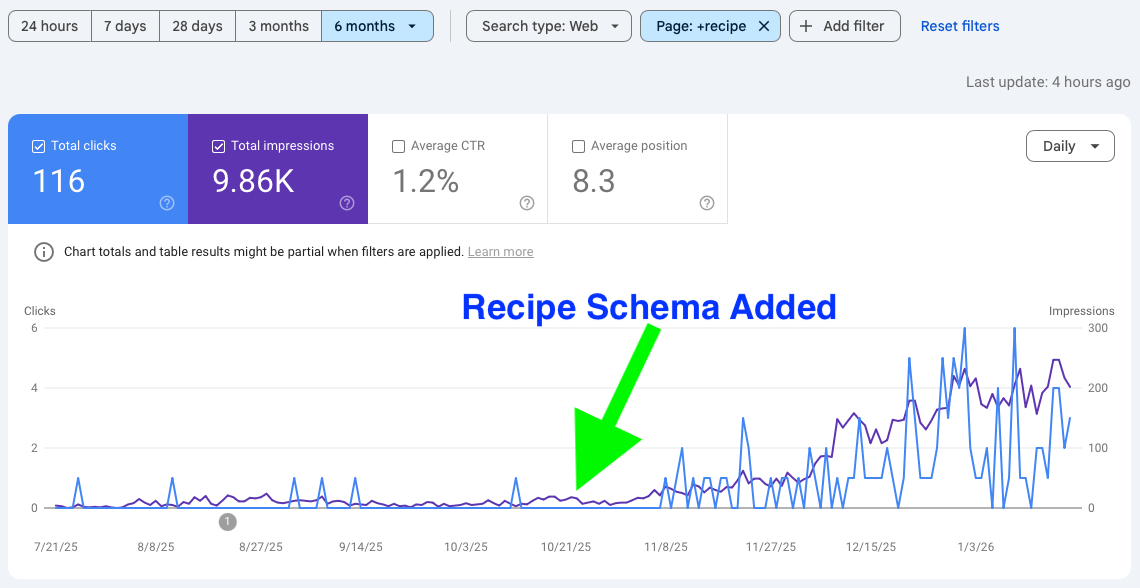
Look at that huge jump the recipes had after given the right schema.
Optimizing What’s There and Filling the Gaps
At the same time, we addressed the blog itself.
The content audit made it very clear that there was almost no bottom-of-the-funnel content. Nothing designed to support buying decisions. Nothing connecting education to products in a meaningful way.
So we:
Removed content that wasn’t helping
Optimized posts that still had value
Filled in gaps intentionally, especially closer to purchase intent
And this part is critical.
Every piece of content is intentionally internally linked to products.
That means when someone lands on a recipe or a blog post, they’re not just reading and leaving. They’re seeing the products that are used, recommended, or relevant to what they’re learning.
They’re being introduced to the catalog naturally.
And based on the sales data, they’re clicking and buying.
This isn’t content for traffic’s sake. It’s content designed to support revenue.
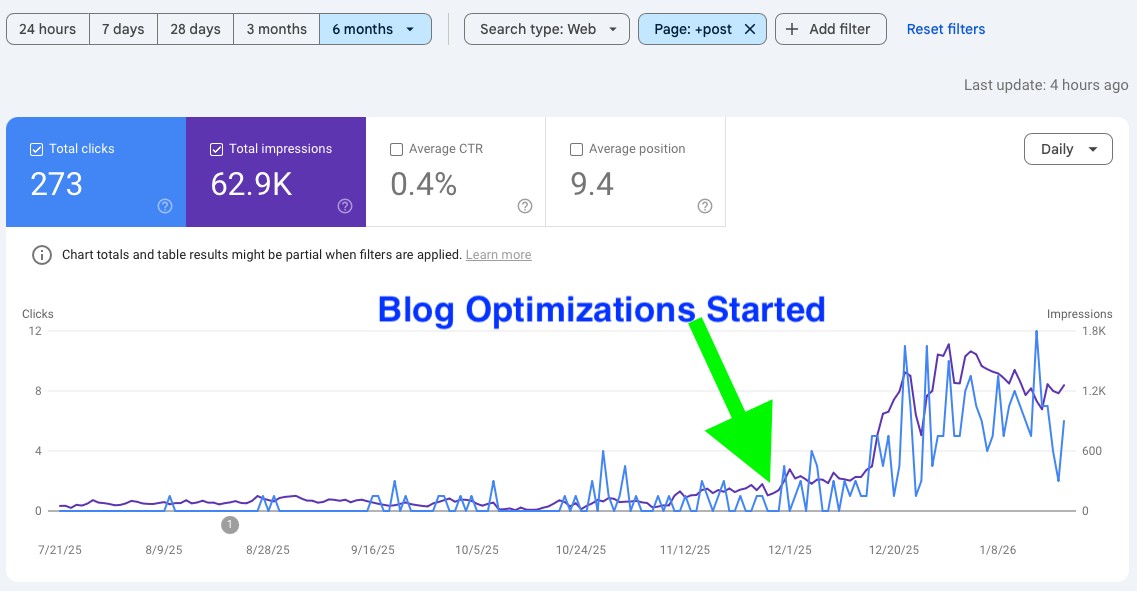
Look at that dramatic growth since we started focusing on the blog (pruning, optimizing, filing gaps).
What the Data Is Showing Right Now
When I look at performance by page type, the pattern is very clear.
Product pages are growing steadily, exactly as expected.
But blog posts and recipe pages are growing faster and driving a significant share of discovery.
Most people are no longer finding the site through product pages first. They’re finding it through content, building familiarity and trust, and then moving into products from there.
Product pages convert demand.
Content creates it.
And when those two are connected properly, the result isn’t just more traffic. It’s more sales.
Triple the sales.
This Is the Part People Miss About Blogging
A lot of businesses say they’ve tried blogging and it didn’t work.
What they usually mean is that they published content without a clear role for it inside the business.
No internal linking strategy.
No connection to products or services.
No thought given to how someone moves from reading to buying.
A blog can’t drive revenue if it’s disconnected from the rest of the site.
But when content is used to support the pages that matter most, it stops being optional. It becomes one of the strongest growth levers you have.
Blogging Is How You Level Up After the Foundations Are Set
Once your site is technically sound and your core pages are optimized, there are only so many gains left to squeeze out of them alone.
To grow beyond that, you need content.
That content might look like:
Recipes
Blog posts
Case studies
Portfolios
Educational resources
Sometimes it’s all of the above.
The format matters less than the intention.
Content expands how people find you, how they understand what you sell, and how confident they feel taking the next step.
That’s what’s happening here. Right now.
This Is Proof That Blogging Can Drive Sales, Not Just Traffic
This isn’t a hypothetical example or a “someday” strategy.
This is active data from a business that already had solid foundations and was ready for the next phase of growth.
The blog isn’t a side project here. It’s a business asset. And it’s doing exactly what it’s supposed to do. Drive revenue.
If your site feels solid but growth has stalled, this is often the missing piece.
Not more products.
Not more tweaks.
But content that supports the entire buying journey.
That’s where the real opportunity is.
If you want help auditing your existing content, identifying the gaps, and building a strategy that connects content to revenue, that’s exactly what I do with clients.
And if you’d rather learn the process yourself, my course, The Content Strategy Blueprint, walks through the same framework step by step.
👉 Learn the framework







Content clusters are one of the most powerful ways to build topical authority, which gets you to rank and to be recommended from AI. Learn how to do it correctly.